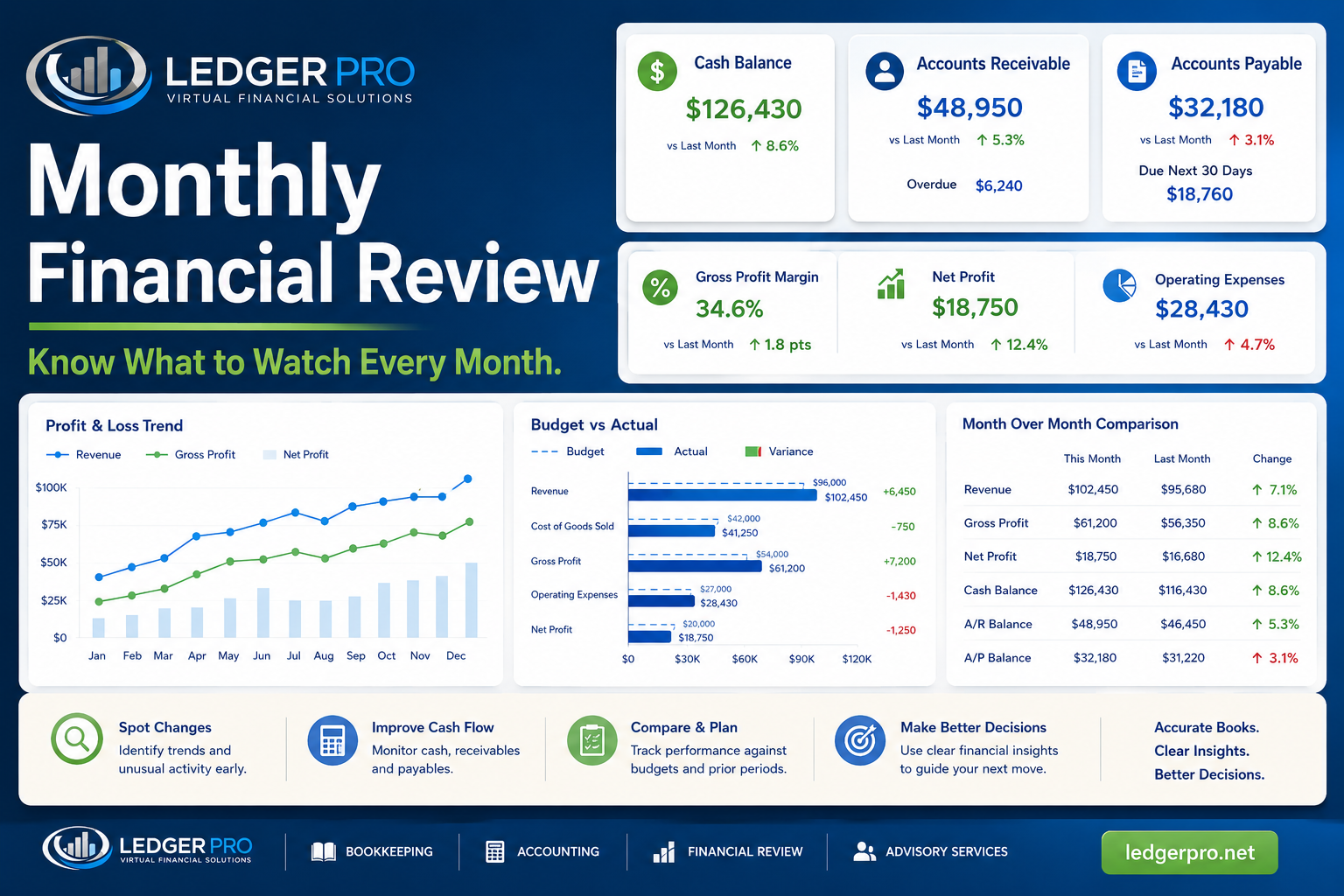
Monthly Financial Review: What Small Business Owners Should Be Watching
A monthly financial review gives business owners a regular opportunity to understand what changed, why it changed and where attention is needed next. It turns accounting records into practical management information instead of leaving important issues until tax season or year-end.
Ledger Pro combines accurate bookkeeping, reconciled accounts and financial analysis to help business owners review performance, cash flow and key financial trends on a consistent basis.
Monthly review creates financial visibility. A regular review process helps identify changes in cash, profitability, receivables, payables and operating costs before they become larger problems.
What Is a Monthly Financial Review?
A monthly financial review is a structured examination of your recent accounting results and financial position. It usually includes the Profit and Loss Statement, Balance Sheet, cash activity, receivables, payables and selected performance indicators.
For broader guidance on interpreting financial information, see
Ledger Pro small business advisory services.
Why Monthly Financial Reviews Matter
- Identify changes in revenue and gross profit.
- Monitor cash balances and working capital.
- Track accounts receivable and overdue customer balances.
- Review supplier obligations and upcoming payments.
- Spot unusual expenses or cost increases.
- Compare current results with prior months or budgets.
- Identify accounting errors or unreconciled balances.
- Support better operating and financial decisions.
What Should You Review Each Month?
The exact review depends on your business, but a practical monthly process should normally include the following areas.
- Profit and Loss Statement.
- Balance Sheet.
- Bank and credit card reconciliations.
- Cash balances and cash flow trends.
- Accounts receivable aging.
- Accounts payable aging.
- Payroll and payroll liabilities.
- Sales and revenue trends.
- Major operating expenses.
- Debt and financing balances.
- Budget versus actual results, where available.
- Unusual or unexplained transactions.
Review Your Profit and Loss Statement
The Profit and Loss Statement shows how revenue and expenses affected your operating result during the month. Reviewing the totals alone is not enough. Look at how individual revenue and expense categories changed compared with prior periods.
- Revenue growth or decline.
- Gross profit and gross margin.
- Payroll and labor costs.
- Operating expenses.
- Net income or loss.
- Unexpected month-to-month changes.
Review the Balance Sheet
The Balance Sheet provides information about what the business owns, what it owes and the financial position at the end of the month.
- Cash and bank balances.
- Accounts receivable.
- Accounts payable.
- Credit card balances.
- Loans and other liabilities.
- Payroll and tax liabilities.
- Owner equity and distributions.
Practical tip: Large or unexplained changes on the Balance Sheet often deserve investigation even when the Profit and Loss Statement appears reasonable.
Watch for Cash Flow Pressure
A profitable month does not guarantee strong cash flow. Customer payment timing, supplier obligations, payroll, taxes and debt payments can all affect available cash.
For a deeper review of cash planning, see
Cash Flow Advisory for Small Businesses.
Review Accounts Receivable
Increasing receivables may signal slower customer collections even when reported sales remain strong.
- Review overdue customer balances.
- Identify customers consistently paying late.
- Compare receivable balances with prior months.
- Confirm payments are being applied correctly.
- Follow up on old or disputed invoices.
Review Accounts Payable
Accounts payable should be reviewed alongside available cash and expected collections. This helps determine which obligations are due and whether upcoming payments create cash pressure.
- Review supplier due dates.
- Identify overdue invoices.
- Check for duplicate or disputed bills.
- Confirm major payments expected in the next month.
- Compare payable balances with prior periods.
Look for Unusual Transactions
Monthly review is also an opportunity to identify transactions that do not match normal activity.
- Large one-time expenses.
- Unexpected revenue adjustments.
- Duplicate transactions.
- Unusual owner withdrawals.
- Old balances that are not clearing.
- Transactions posted to incorrect accounts.
Which Ledger Pro Service Level Fits Your Business?
The level of support should reflect how much accounting work your business handles internally and how much financial review you need.
- Routine accounting support: Bookkeeping, reconciliations and accurate financial records.
- Accounting plus review: Monthly or periodic financial review and management reporting.
- Advisory support: Deeper analysis, cash flow review, forecasting and ongoing financial guidance.
View Ledger Pro Plans & Pricing
What You Get With Ledger Pro
- Experienced accounting support.
- Review of reconciled financial information.
- Identification of unusual balances and trends.
- Review of cash, receivables and payables.
- Clear explanation of monthly financial results.
- Practical recommendations based on your accounting information.
Start With Reliable QuickBooks Information
A monthly financial review depends on accurate accounting records. Unreconciled accounts, duplicate transactions, old balances and coding errors can distort the information used for management decisions.
Ledger Pro's QuickBooks review process helps identify areas requiring attention before relying on the financial statements.
View the QBO Client Review Benchmark
Turn Monthly Reporting Into Better Decisions
The value of a monthly financial review comes from acting on what the numbers show. The review may identify collection issues, rising expenses, weak margins, cash pressure or opportunities to improve financial performance.
Need help reviewing your monthly financial results? Ledger Pro provides remote accounting and advisory support designed around the financial needs of small businesses and organizations.
Contact Ledger Pro
Frequently Asked Questions
How often should a small business review financial statements?
Many active businesses benefit from a monthly review. Businesses with simpler activity may use quarterly reviews, while businesses facing cash pressure or rapid growth may need more frequent monitoring.
What financial statements should I review every month?
The Profit and Loss Statement and Balance Sheet are the core reports. Cash balances, receivables, payables and reconciliations should also form part of the review.
Why does my profit differ from my bank balance?
Profit and cash flow measure different things. Customer payment timing, unpaid bills, loan payments, asset purchases and owner distributions can cause available cash to differ significantly from reported profit.
Do I need QuickBooks Online for a monthly financial review?
The review depends on reliable accounting information. Ledger Pro works extensively with QuickBooks Online, but the available accounting records determine the scope of the review.