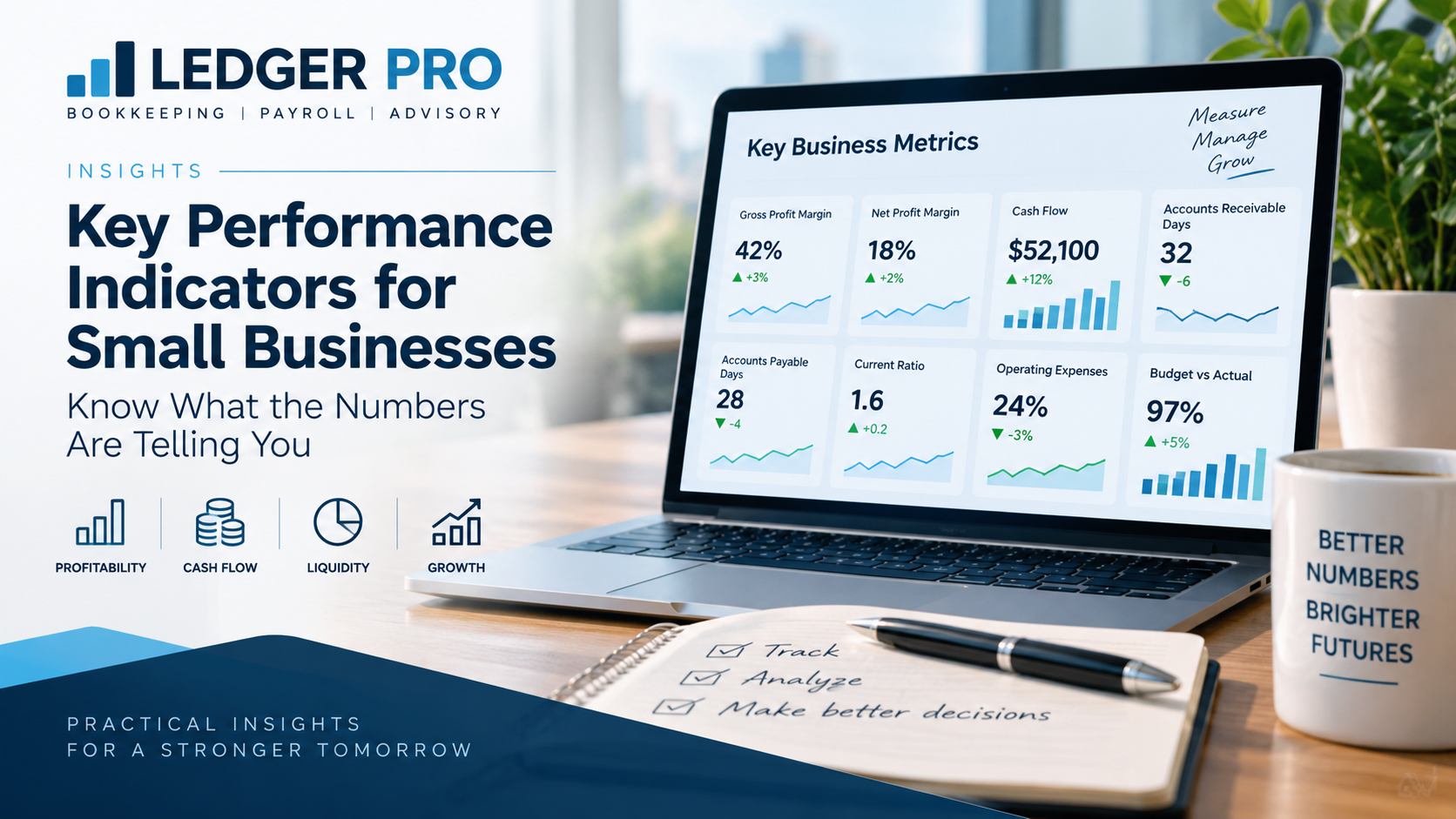
Financial statements tell you what has happened in your business. Key performance indicators help you understand what those numbers are telling you and whether the business is moving in the right direction.
Key performance indicators for small businesses, commonly called KPIs, are selected financial and operational measurements used to monitor performance, identify trends and support better business decisions. The most useful KPIs are not simply numbers on a dashboard. They connect financial results with the areas of the business that owners and managers can actually influence.
Small business owners often have access to substantial financial information through their accounting system. The challenge is deciding which numbers deserve attention. A focused set of KPIs can make financial information easier to interpret and more useful for decision-making.
KPIs are particularly valuable when reviewed consistently. A single month's result may not mean very much on its own. Comparing the same measures over several months can reveal trends that deserve attention.
The appropriate KPIs depend on the type of business, its objectives and its financial structure. However, several measurements are useful across many small businesses.
Revenue growth measures how sales are changing over time. It can be compared monthly, quarterly or annually to identify whether the business is expanding, remaining stable or experiencing declining sales.
Gross profit margin shows how much revenue remains after the direct costs associated with producing goods or delivering services.
Monitoring the margin over time can help identify changes in pricing, supplier costs, labor costs and the profitability of the company's underlying activities.
For a broader discussion of margins and business profitability, review our profitability analysis guide for small businesses .
Net profit margin measures the amount of profit remaining after operating expenses and other applicable costs are considered. It provides a broader view of whether the overall business model is producing adequate financial returns.
A declining net margin may indicate rising overhead, pricing pressure or expenses increasing faster than revenue.
Tracking operating expenses helps management understand where money is being spent and whether costs remain proportionate to the size of the business.
Rather than focusing only on the total amount, review major expense categories and compare them with previous periods and budget expectations.
See our expense management guide for small businesses for additional guidance on monitoring and controlling business costs.
Profit and cash are not the same. A profitable business can still experience cash shortages when customers pay slowly, expenses must be paid sooner or funds are tied up elsewhere in the business.
Operating cash flow helps show whether normal business activities are generating sufficient cash to support operations.
Learn more in our cash flow advisory guide for small businesses .
Businesses that sell on credit should monitor how quickly customers are paying. Increasing receivable balances or a growing number of overdue invoices can create liquidity pressure even when reported revenue remains strong.
Our accounts receivable management guide explains how collections affect cash flow and working capital.
Accounts payable should be reviewed alongside cash balances and expected receipts. This helps management understand upcoming obligations and plan the timing of vendor payments.
Review our accounts payable management guide for small businesses for more information.
Working capital is generally calculated as current assets minus current liabilities. It provides an indication of the financial resources available to support short-term business operations.
A business may report profits while experiencing working capital pressure because too much cash is tied up in receivables or other current assets.
See our working capital management guide for small businesses for a more detailed explanation.
A KPI dashboard does not need dozens of measurements. In many cases, a smaller group of carefully selected indicators provides more useful information than a large dashboard filled with numbers.
KPIs become more useful when they are compared with expectations. Reviewing actual results against budgets and forecasts helps management determine whether the business is performing according to plan.
Significant differences should lead to questions. Was revenue lower than expected? Did payroll or operating costs increase? Are customers taking longer to pay? Has a planned investment affected cash reserves?
These comparisons are explored further in our budget versus actual analysis guide and financial forecasting guide for small businesses .
Review frequency depends on the KPI and the needs of the business. Some measures require closer monitoring than others.
A structured monthly financial review provides a useful framework for bringing these measurements together.
Ledger Pro helps small businesses turn accounting information into practical financial insight. Depending on the level of support required, our accounting and advisory services can help you:
A KPI is only as reliable as the accounting information behind it. Unreconciled accounts, incorrectly classified transactions and unusual balances can distort financial measurements and lead to incorrect conclusions.
Ledger Pro's QuickBooks Online review process provides a structured way to assess the underlying accounting records before relying on them for management reporting.
View the QBO Client Review Benchmark
Effective financial management is not about tracking every number. It is about identifying the measurements that matter, reviewing them consistently and understanding what they mean for your business.
Ledger Pro provides remote accounting, financial review and advisory support to help small businesses gain better visibility into their financial performance.
View Ledger Pro Plans & Pricing Contact Ledger Pro
Key performance indicators are selected financial or operational measurements used to monitor business performance, identify trends and support management decisions.
The appropriate KPIs vary by business, but common measures include revenue growth, gross profit margin, net profit margin, operating expenses, cash flow, accounts receivable, accounts payable and working capital.
Many financial KPIs should be reviewed monthly. Cash balances, collections and immediate payment obligations may need weekly monitoring when cash flow requires closer management.
QuickBooks can provide much of the accounting information needed to calculate and monitor financial KPIs. However, the underlying bookkeeping and reconciliations should be accurate before the information is relied upon for management decisions.