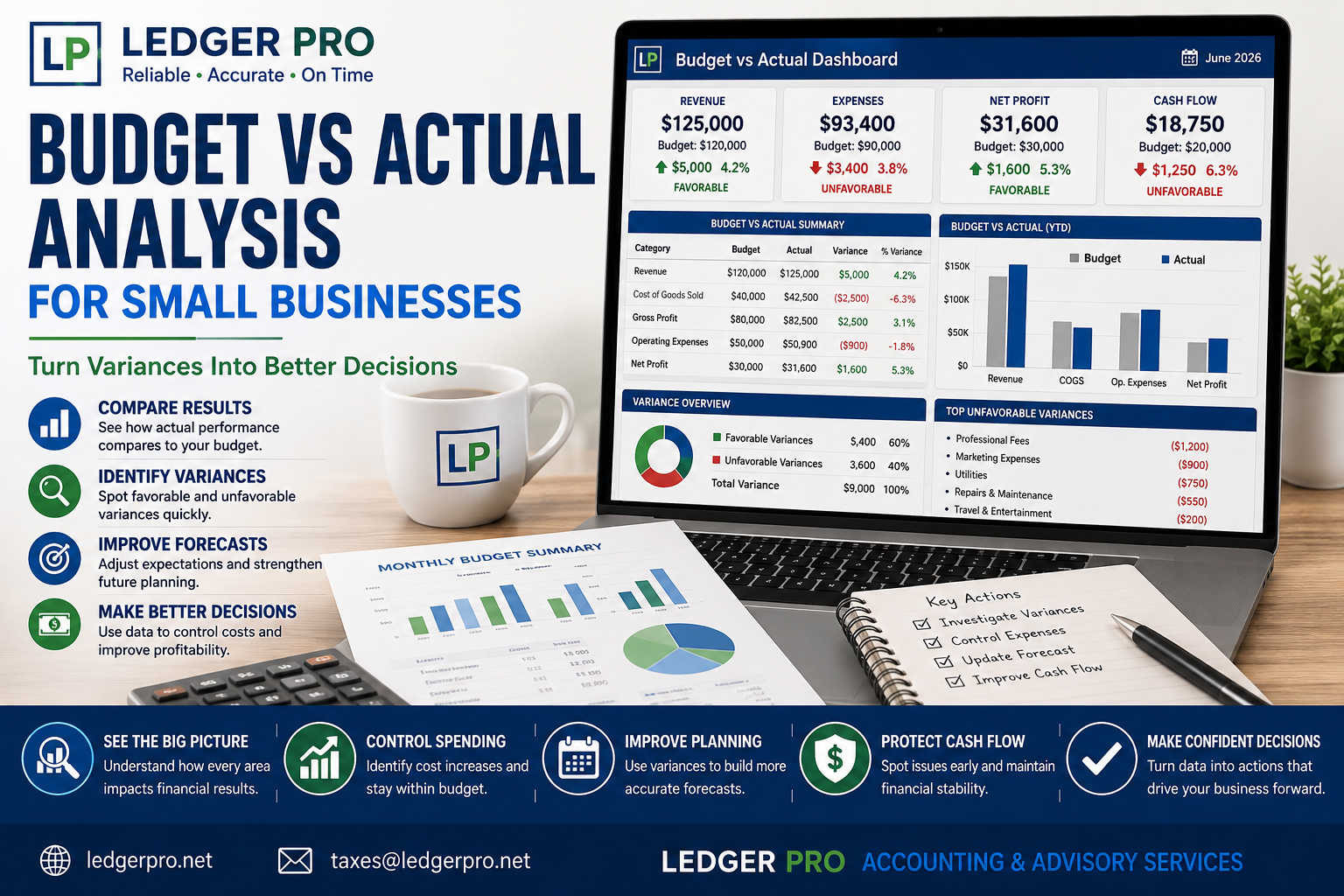
Budget vs Actual Analysis for Small Businesses: Turn Variances Into Better Decisions
A budget establishes expectations for revenue, expenses, cash requirements and
financial performance. Actual results show what happened. Comparing the two helps
business owners understand where performance differs from plan and why.
Budget vs actual analysis turns financial reporting into a management tool.
Instead of reviewing numbers in isolation, you compare results with expectations
and identify areas requiring attention.
A variance is a signal to investigate.
Differences between budget and actual results can highlight changing sales,
rising costs, timing differences or assumptions that need to be updated.
What Is Budget vs Actual Analysis?
Budget vs actual analysis compares planned financial results with the amounts
recorded in your accounting system. The difference between those amounts is
called a variance.
Variances can be favorable or unfavorable, but the direction alone does not
explain the underlying business issue. Management should understand what caused
the difference and whether action is required.
For broader financial decision support, see
Ledger Pro Small Business Advisory Services
.
Why Budget vs Actual Analysis Matters
-
Identify revenue shortfalls.
Compare expected sales with actual results.
-
Control expenses.
Detect spending that is exceeding expectations.
-
Improve forecasting.
Update assumptions when actual performance changes.
-
Protect cash flow.
Identify financial pressure before it becomes urgent.
-
Improve accountability.
Understand where results differ from operating plans.
-
Support better decisions.
Focus management attention on significant variances.
What Should Be Compared?
The most useful budget review focuses on the financial areas that influence
profitability, cash flow and operating performance.
- Revenue by product, service or business segment
- Cost of goods sold
- Gross profit and gross margin
- Payroll and labor costs
- Operating expenses
- Marketing and selling expenses
- Professional fees
- Rent and occupancy expenses
- Capital expenditures
- Debt payments
- Cash balances and working capital
Understand Favorable and Unfavorable Variances
A favorable variance generally means results were better than expected.
An unfavorable variance means results were worse than planned. Context still matters.
-
Revenue above budget:
Often favorable, but review whether margins remained healthy.
-
Revenue below budget:
Investigate sales volume, pricing and customer activity.
-
Expenses below budget:
Often favorable, unless important activities were delayed.
-
Expenses above budget:
Review price increases, volume changes and unexpected spending.
-
Cash below forecast:
Review collections, payments and timing assumptions.
Do Not Focus Only on the Largest Dollar Variance
A large dollar difference deserves attention, but percentage changes and recurring
patterns can also reveal important issues.
- Review both dollar and percentage variances.
- Look for recurring differences across several months.
- Separate timing differences from permanent changes.
- Investigate changes in underlying business activity.
- Consider whether the original budget assumptions remain realistic.
A budget should not become outdated financial history.
If business conditions change materially, update your forecast so management is
comparing future expectations with current information.
Connect Variances With Profitability
Revenue growth does not always lead to stronger profit. Budget analysis should
therefore include gross margin, operating expenses and net income.
A business may exceed its sales target while producing less profit than expected
because costs increased faster than revenue.
Read the Profitability Analysis Guide
Review Expense Variances
Expense variances help identify where spending differs from expectations.
Recurring increases should be reviewed to determine whether they reflect higher
prices, changing business activity or spending that needs greater control.
Read the Expense Management Guide
Include Cash Flow in the Analysis
Profit and cash are not the same. A business can meet its profit target while
experiencing cash pressure because customers pay slowly, inventory increases or
significant obligations become due.
Budget reviews should therefore include cash balances, receivables, payables and
expected future obligations.
Read the Cash Flow Advisory Guide
How Often Should Budget vs Actual Results Be Reviewed?
-
Monthly:
Review major revenue, expense, profit and cash variances.
-
Quarterly:
Reassess assumptions and update forecasts where needed.
-
Annually:
Use historical results and current expectations to prepare the next operating budget.
-
After significant changes:
Reforecast when revenue, costs or business conditions change materially.
Practical tip:
Monthly variance analysis works best when accounting records are current and
reconciled before reports are compared with budget.
Use Your Monthly Financial Review
Budget vs actual analysis should form part of a broader monthly financial review.
Profitability, cash, receivables, payables and expenses provide important context
when interpreting variances.
Read the Monthly Financial Review Guide
Which Ledger Pro Plan Fits Your Business?
-
Essential:
Appropriate for businesses primarily needing accurate bookkeeping and
reconciled accounting records.
-
Growth:
Suitable for businesses needing regular financial review, expense monitoring
and greater visibility into operating performance.
-
Premium:
Designed for businesses requiring deeper financial analysis, budgeting,
forecasting and ongoing advisory support.
View Ledger Pro Plans & Pricing
What You Get With Ledger Pro
- Experienced accounting and financial review support
- Review of actual results against budgets or expectations
- Identification of significant financial variances
- Analysis of expense and profitability trends
- Cash flow and working capital visibility
- Financial information explained in practical business terms
Turn Variances Into Management Action
The purpose of variance analysis is not simply to explain why actual numbers
differ from budget. The value comes from deciding whether pricing, spending,
cash planning, operations or financial expectations should change.
Need help understanding your financial variances?
Ledger Pro provides remote accounting, financial review and advisory support
designed around the financial needs of small businesses and organizations.
Contact Ledger Pro
Frequently Asked Questions
What is a budget variance?
A budget variance is the difference between an amount planned in the budget and
the actual financial result recorded for the same period.
How often should budget vs actual results be reviewed?
Monthly review is appropriate for many businesses. Quarterly reviews provide an
opportunity to reassess assumptions and update forecasts.
Should a budget be changed during the year?
The original budget can remain useful as a benchmark, while an updated forecast
reflects new information and changing business expectations.
Why can actual profit differ from budget even when revenue is on target?
Profit may differ because gross margin, payroll, operating costs or other
expenses changed from the assumptions used when the budget was prepared.
Start With Reliable QuickBooks Information
Budget comparisons depend on accurate accounting information. Unreconciled
accounts, duplicate transactions or incorrect classifications can produce
misleading variance reports.
View the QBO Client Review Benchmark