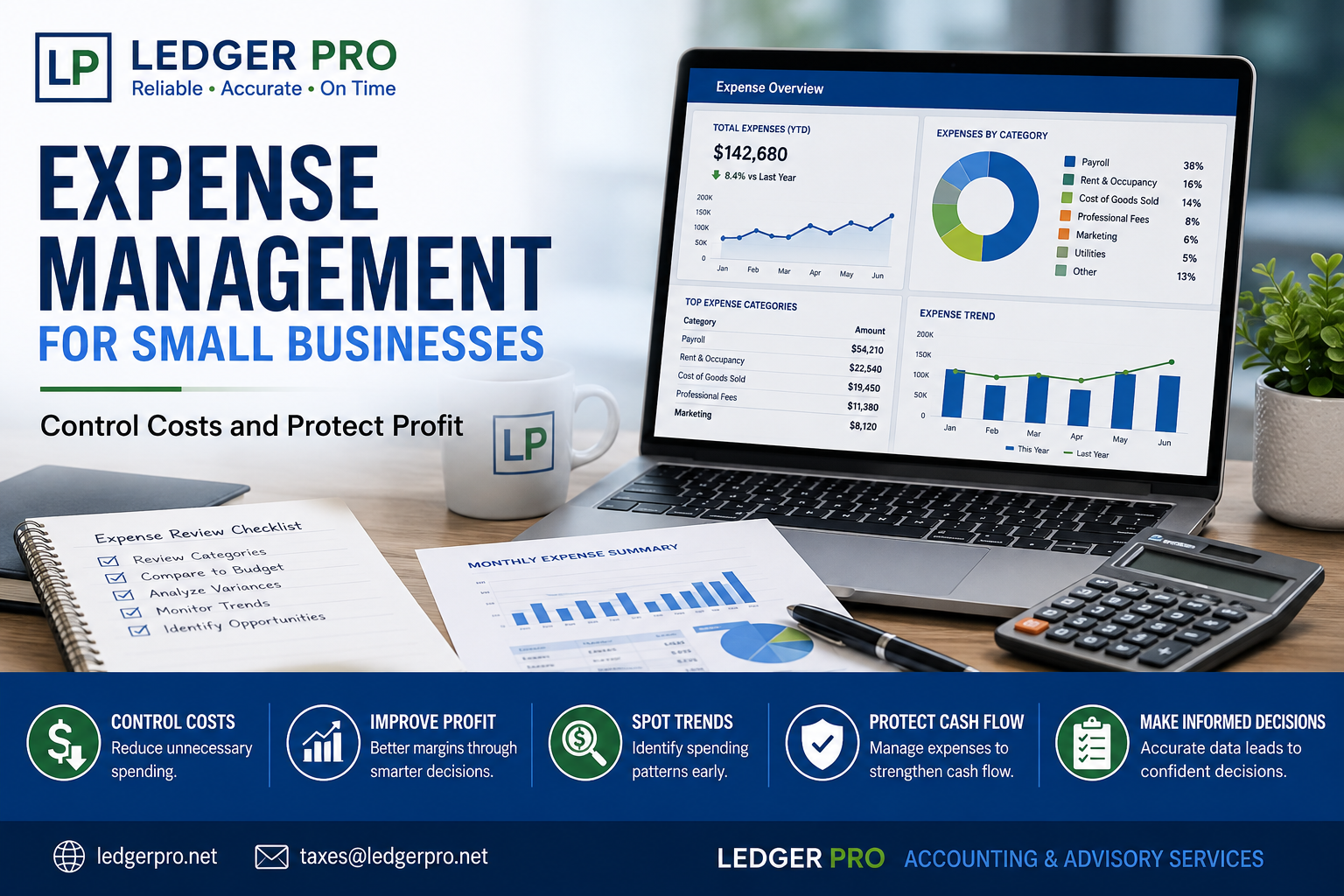
Expense Management for Small Businesses: Control Costs and Protect Profit
Business expenses directly affect profitability, cash flow and the amount of
working capital available to operate your business. Revenue can increase while
profit declines if operating costs grow faster than sales.
Effective expense management helps business owners understand where money is
being spent, identify changing cost patterns and make informed decisions before
unnecessary expenses weaken financial performance.
Good expense management starts with visibility.
Reviewing where your money is going helps you identify spending trends,
control costs and understand how expenses are affecting profit and cash flow.
What Is Small Business Expense Management?
Expense management is the process of recording, categorizing, reviewing and
controlling the costs incurred while operating a business. It covers recurring
operating expenses, vendor costs, payroll-related expenses, professional fees,
occupancy costs and other expenditures.
The objective is not simply to reduce spending. The goal is to understand which
expenses support the business, which costs are changing and whether spending
remains consistent with revenue, budgets and operating priorities.
Why Expense Management Matters
- Protect profitability. Rising costs can reduce profit even when sales are growing.
- Improve cash flow. Understanding upcoming and recurring expenses supports better cash planning.
- Identify cost increases. Regular reviews make changes in vendor pricing and operating costs easier to spot.
- Improve budgeting. Accurate expense information provides a stronger basis for forecasts and budgets.
- Support better decisions. Reliable expense data helps management decide where resources should be allocated.
What Should Be Reviewed?
A useful expense review looks beyond the total amount spent. Business owners
should understand where expenses are occurring and how those costs are changing.
- Operating expenses by category
- Current expenses compared with prior periods
- Actual spending compared with budget
- Recurring subscriptions and service charges
- Vendor costs and price increases
- Payroll and contractor expenses
- Rent, utilities and occupancy costs
- Professional and administrative expenses
- Marketing and selling expenses
- Unusual or one-time transactions
- Duplicate or incorrectly categorized expenses
Expense Categories Worth Monitoring
The categories that matter most depend on your business. Several expense groups
deserve consistent attention because changes in these areas often have a direct
effect on margins and cash flow.
- Payroll and labor: salaries, wages, payroll taxes, benefits and contractor costs.
- Cost of goods sold: inventory, materials and other direct costs associated with generating revenue.
- Occupancy: rent, utilities, maintenance and related facility costs.
- Professional services: accounting, legal, consulting and other outside services.
- Technology: software subscriptions, cloud services, communications and technology support.
- Marketing: advertising, promotions, digital marketing and customer acquisition costs.
Expense Warning Signs to Watch
Individual expenses do not always appear significant. Patterns across several
months often provide a clearer indication of developing problems.
- Expenses increasing faster than revenue
- Recurring charges for services that are no longer needed
- Large unexplained month-to-month changes
- Vendor costs increasing without review
- Frequent miscellaneous or uncategorized expenses
- Actual spending consistently exceeding budget
- Declining gross or net profit margins
- Duplicate payments or transactions
Watch the trend, not only the transaction.
A small recurring increase can become a significant annual expense.
Monthly comparisons help identify these changes sooner.
How Often Should Expenses Be Reviewed?
Most businesses benefit from reviewing expenses every month as part of the
financial close and management reporting process.
- Monthly: review expense categories, unusual transactions, recurring costs and major variances.
- Quarterly: evaluate vendor costs, subscriptions, budget performance and broader spending trends.
- Annually: review the complete cost structure when preparing budgets and financial plans.
Practical tip:
Compare expenses with both the previous month and the same period from the
prior year. This helps separate normal seasonal changes from developing cost problems.
Expense Management and Profitability
Expense management should be considered alongside revenue and profitability.
Higher sales do not automatically produce higher profit if operating costs are
increasing at the same time.
Reviewing gross margin, operating expenses and net income together provides a
clearer picture of whether business growth is translating into stronger
financial results.
Read the Profitability Analysis Guide
Connect Expenses With Cash Flow
Profitability and cash flow are related, but they measure different aspects of
financial performance. Expense timing affects how much cash is available to pay
vendors, employees, taxes and other obligations.
Combining expense analysis with cash flow review helps business owners anticipate
upcoming requirements instead of reacting after cash becomes tight.
Read the Cash Flow Advisory Guide
Use Your Monthly Financial Review
Expense analysis becomes more useful when it forms part of a broader monthly
financial review. Profit and loss results, cash balances, receivables, payables
and expenses should be evaluated together.
Read the Monthly Financial Review Guide
Which Ledger Pro Plan Fits Your Business?
-
Essential:
Best suited to businesses requiring reliable bookkeeping and routine
financial record maintenance.
-
Growth:
Suitable for businesses needing more regular financial review and greater
visibility into expenses, cash flow and operating performance.
-
Premium:
Designed for businesses requiring broader financial analysis, management
reporting and ongoing advisory support.
View Ledger Pro Plans & Pricing
What You’ll Get With Ledger Pro
- Accurate accounting records and expense categorization
- Review of operating expense trends
- Identification of unusual balances and transactions
- Better visibility into cash flow and profitability
- Financial information organized for management review
- Remote accounting and advisory support
Better financial information supports better decisions.
Ledger Pro combines accurate accounting with practical financial review so
business owners have a clearer understanding of costs, cash flow and profitability.
Take the Next Step
If your business needs better visibility into expenses, cash flow and financial
performance, Ledger Pro provides remote accounting and advisory support designed
around your business needs.
View Ledger Pro Plans & Pricing
Contact Ledger Pro
Frequently Asked Questions
What is expense management for a small business?
Expense management involves recording, categorizing, reviewing and controlling
business costs. It helps owners understand where money is being spent and how
those expenses affect profitability and cash flow.
How often should business expenses be reviewed?
A monthly review is appropriate for most businesses. Larger expenses, unusual
transactions and cash requirements may require more frequent attention.
What is the difference between expenses and accounts payable?
An expense represents a cost incurred by the business. Accounts payable represents
amounts owed to vendors or suppliers that have not yet been paid. An expense can
therefore exist even when payment will occur later.
Does reducing expenses always increase profit?
Lower expenses can improve profit when other factors remain unchanged, but cost
reductions should be evaluated carefully. Cutting spending that supports sales,
operations or customer service may negatively affect business performance.
Related Financial Insights
QuickBooks Financial Review
Accurate expense reporting depends on accurate accounting records. Ledger Pro's
QuickBooks Online review process helps identify unusual balances, unreconciled
accounts and other areas requiring attention.
View the QBO Client Review Benchmark