Financial Forecasting for Small Businesses: Plan Ahead With Better Financial Visibility
Financial forecasting helps business owners look beyond current results and
estimate what revenue, expenses, profit and cash flow might look like in the
months ahead.
A useful forecast combines historical accounting information with current
business conditions and reasonable assumptions. The objective is to identify
future financial needs early enough to make informed decisions.
Forecasting improves financial visibility.
A forward-looking financial plan helps you anticipate cash requirements,
evaluate business decisions and prepare for changes before they become urgent.
What Is Financial Forecasting?
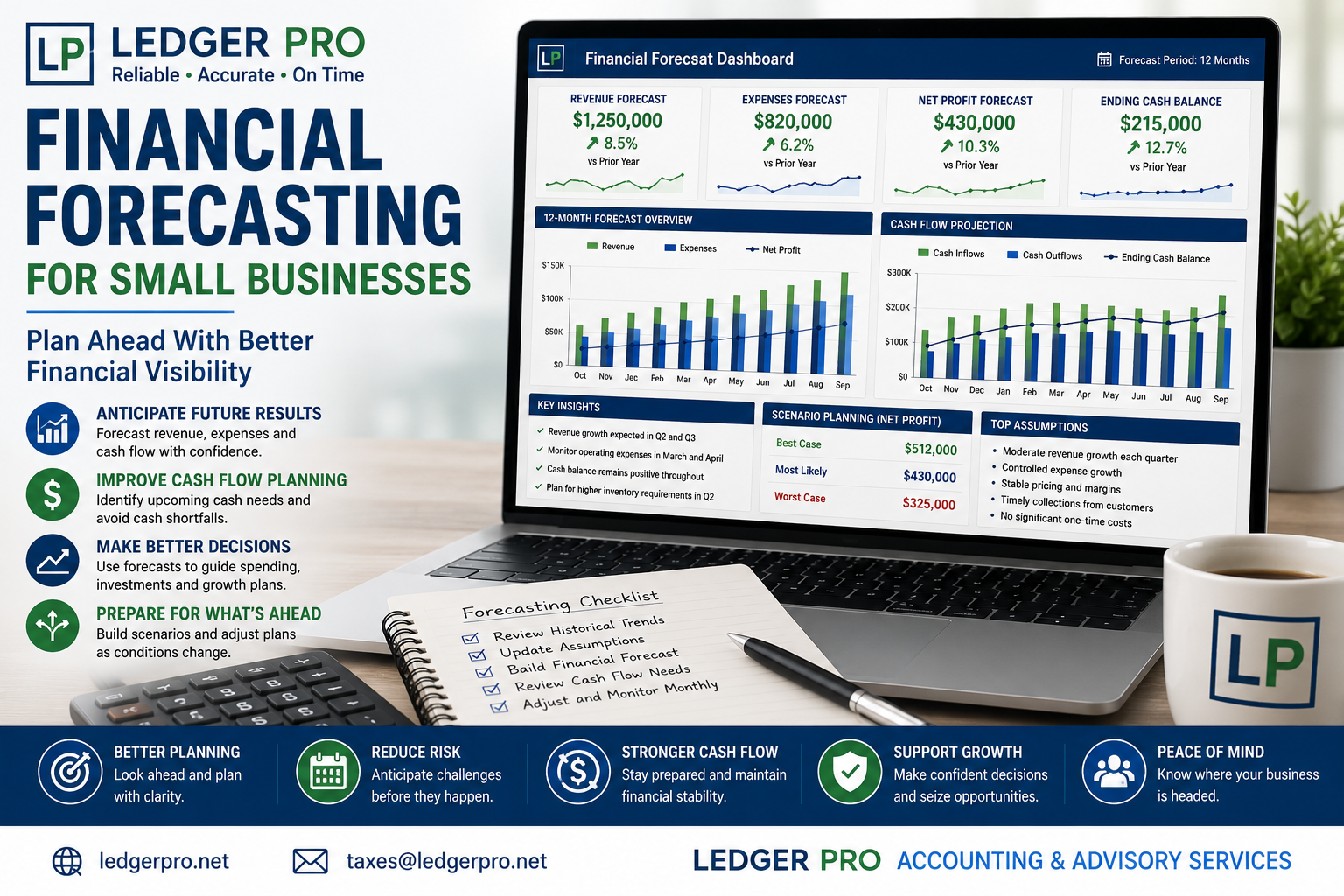
Financial forecasting estimates future financial performance using historical
results, current trends and assumptions about future business activity.
Forecasts commonly include revenue, operating expenses, profitability, cash
inflows, cash outflows and expected ending cash balances.
For broader financial decision support, see
Ledger Pro Small Business Advisory Services
.
Why Financial Forecasting Matters
- Anticipate cash needs. Identify periods when available cash may become tight.
- Plan expenses. Estimate future operating costs and major obligations.
- Evaluate growth. Understand the financial effect of expansion or increased sales.
- Prepare for uncertainty. Model alternative financial outcomes.
- Improve decision-making. Consider future financial consequences before committing resources.
- Support budgeting. Use current information to strengthen future financial plans.
What Should a Financial Forecast Include?
- Projected revenue
- Cost of goods sold
- Gross profit and gross margin
- Payroll and labor costs
- Operating expenses
- Accounts receivable collections
- Accounts payable and vendor payments
- Tax obligations
- Debt payments
- Capital expenditures
- Cash inflows and outflows
- Projected ending cash balance
Start With Revenue Forecasting
Revenue forecasting estimates future sales based on recent performance,
customer activity, pricing, seasonality and expected changes in business volume.
- Historical sales: Review recent monthly and annual revenue trends.
- Customer activity: Consider recurring customers, contracts and expected new business.
- Pricing: Include planned price increases or discounts.
- Seasonality: Account for predictable periods of higher or lower activity.
- Business changes: Consider new services, locations, products or customer losses.
Forecast Operating Expenses
Revenue forecasts are only useful when expected costs are considered at the
same time. Some expenses remain relatively stable, while others change with
sales volume or business growth.
Review recurring costs, payroll, vendor pricing, subscriptions, occupancy costs
and other significant operating expenses.
Read the Expense Management Guide
Build Cash Flow Into the Forecast
Profit forecasts do not automatically show when cash will enter or leave the
business. Customer payment timing, vendor obligations, payroll, taxes and debt
payments can create cash pressure even when projected profit remains positive.
A cash flow forecast converts expected business activity into estimated cash
inflows, cash outflows and future bank balances.
Read the Cash Flow Advisory Guide
Include Accounts Receivable Assumptions
Forecasted revenue does not become available cash until customers pay.
Collection timing should therefore form part of your financial forecast.
Review current receivables, payment terms, customer payment patterns and overdue
balances when estimating future cash collections.
Read the Accounts Receivable Guide
Include Accounts Payable and Upcoming Obligations
Future vendor payments should also be included. Review bills already outstanding,
expected purchases, recurring expenses and other obligations becoming due during
the forecast period.
Read the Accounts Payable Guide
Forecasting Warning Signs
- Revenue assumptions increasing without supporting business activity.
- Expenses being held flat despite known cost increases.
- Ignoring customer collection delays.
- Excluding taxes, debt payments or major vendor obligations.
- Using outdated historical information.
- Relying on one forecast without considering alternative outcomes.
- Failing to update the forecast when conditions change.
A forecast is not a guarantee.
It is a financial planning tool based on assumptions. Those assumptions should
be reviewed and updated as new information becomes available.
Use Scenario Planning
Scenario planning helps management understand how different assumptions could
affect future financial performance.
- Base case: The outcome considered most likely based on current information.
- Best case: The financial effect of stronger sales, faster collections or lower costs.
- Downside case: The effect of lower revenue, delayed collections or higher expenses.
Practical tip:
A downside scenario helps identify how much financial flexibility your business
has before cash becomes constrained.
Compare Forecasts With Actual Results
Forecasting should not stop after the forecast is prepared. Compare actual
financial results with previous expectations and investigate significant differences.
This process improves future assumptions and helps management understand why
performance is changing.
Read the Budget vs Actual Analysis Guide
Connect Forecasting With Profitability
Financial forecasts should include more than revenue growth. Gross margin,
operating expenses and net profit help determine whether expected growth is
likely to improve overall financial performance.
Read the Profitability Analysis Guide
How Often Should a Financial Forecast Be Updated?
- Monthly: Update forecasts for businesses requiring close cash flow or performance monitoring.
- Quarterly: Reassess major assumptions and financial expectations.
- After major changes: Update the forecast after material changes in sales, costs, staffing or financing.
- Before major decisions: Review forecasts before significant hiring, purchases, investments or distributions.
Rolling forecasts can be useful because they continually extend the planning
horizon as each month is completed.
Use Your Monthly Financial Review
Forecasts work best when they are built on current financial information.
Monthly review of profit, cash, receivables, payables and expenses provides the
foundation for more reliable forward-looking analysis.
Read the Monthly Financial Review Guide
Which Ledger Pro Plan Fits Your Business?
-
Essential:
Appropriate for businesses primarily requiring accurate bookkeeping and
reconciled financial records.
-
Growth:
Suitable for businesses needing regular financial review and greater
visibility into cash flow and operating performance.
-
Premium:
Designed for businesses requiring deeper financial analysis, forecasting,
scenario planning and ongoing advisory support.
View Ledger Pro Plans & Pricing
What You Get With Ledger Pro
- Experienced accounting and financial review support
- Review of historical financial trends
- Cash flow and working capital analysis
- Support developing practical financial forecasts
- Scenario analysis for changing business conditions
- Financial information explained in practical business terms
Plan Ahead With Better Financial Information
Financial forecasting gives business owners a structured way to think about
future revenue, expenses, cash requirements and financial decisions.
Need help developing a financial forecast?
Ledger Pro provides remote accounting, financial review and advisory support
designed around the needs of small businesses and organizations.
Contact Ledger Pro
Frequently Asked Questions
What is financial forecasting?
Financial forecasting estimates future revenue, expenses, profitability and
cash flow using historical results, current trends and assumptions about future
business activity.
What is the difference between a budget and a forecast?
A budget generally establishes a financial plan for a defined period. A forecast
uses current information to estimate where financial performance is heading and
can be updated throughout the year.
How far ahead should a small business forecast?
Many businesses use a 12-month forecast. Shorter cash flow forecasts may also be
useful when managing immediate liquidity requirements.
How often should a forecast be updated?
Monthly or quarterly updates are appropriate for many businesses. Forecasts
should also be updated after significant changes in revenue, expenses, staffing,
financing or other business conditions.
Start With Reliable QuickBooks Information
Forecasts depend on reliable historical accounting information. Unreconciled
accounts, duplicate transactions, old balances or incorrect classifications can
distort the financial trends used to build projections.
View the QBO Client Review Benchmark