A business can generate sales and still struggle to make a profit. One of the most useful ways to understand the relationship between sales, costs and profitability is through break-even analysis.
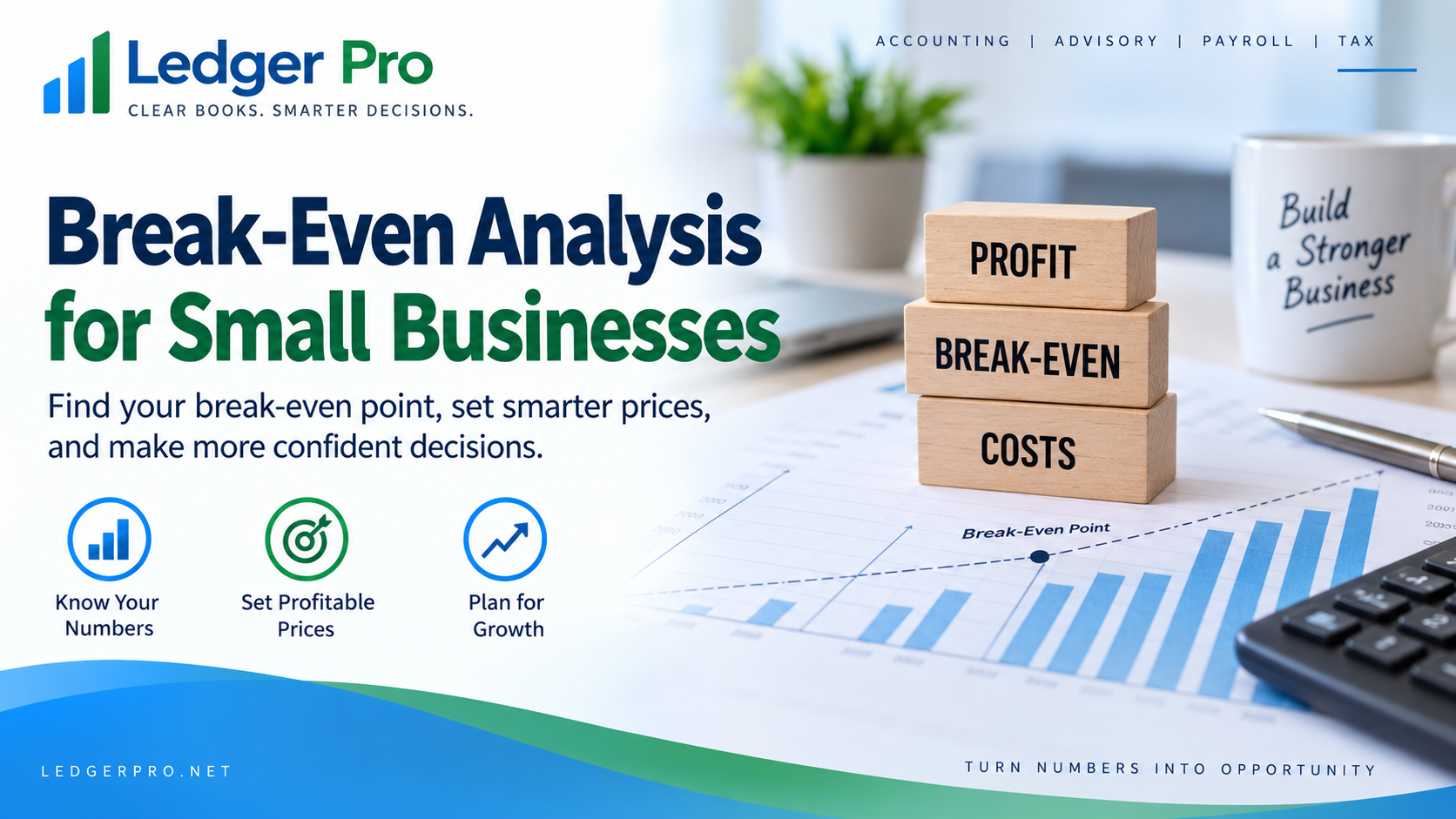
Break-even analysis helps determine how much a business needs to sell before its revenue covers its costs. Once the business moves beyond that point, additional contribution from sales can begin generating profit.
Understanding your break-even point gives you a practical financial benchmark for evaluating sales targets, pricing, expenses and business decisions.
Break-even analysis works particularly well alongside profitability analysis because it connects the cost structure of the business directly to the amount of revenue required to become profitable.
A useful break-even calculation starts with understanding several basic financial components.
Fixed costs generally do not change significantly as sales volume rises or falls within the normal operating range of the business.
Variable costs generally change in relation to sales or production volume. Depending on the business, these might include inventory, materials, commissions, transaction fees or other costs directly associated with delivering a product or service.
Accurate expense classification is important. Our Expense Management for Small Businesses guide explains why understanding where money is being spent is essential for controlling costs and protecting profit.
Selling price determines how much revenue is generated from each unit, service or transaction. A price that appears attractive from a sales perspective may still be inadequate if it does not provide sufficient contribution toward overhead and profit.
Contribution margin represents the amount remaining from sales after variable costs have been deducted. That amount is available to cover fixed costs and, after fixed costs have been covered, contribute toward profit.
For a business selling units, a basic break-even calculation can be expressed as:
For example, assume a business has $10,000 in monthly fixed costs. It sells a product for $100 and incurs $60 of variable cost for each unit sold.
In this simplified example, the business must sell approximately 250 units, generating $25,000 in revenue, before the contribution margin covers its $10,000 of fixed costs.
Pricing decisions can significantly change the break-even point. Reducing prices may increase sales volume, but it also reduces the contribution generated by each sale unless costs fall at the same time.
Conversely, an appropriate price increase can improve contribution margin and reduce the amount of sales required to cover fixed costs.
Reaching break-even means the business has covered its costs. It does not mean the business has achieved its desired profit.
Once the break-even point is known, management can establish a target profit and determine the sales level needed to achieve it. This makes break-even analysis useful when developing budgets and financial forecasts .
One of the strongest uses of break-even analysis is testing how changes in the business could affect profitability.
These scenarios can also be incorporated into your key performance indicator review so that sales, margins and profitability are monitored together.
Break-even analysis is primarily a profitability tool. A business can reach accounting break-even and still experience cash pressure because the timing of cash receipts and payments may be different from when revenue and expenses are recognized.
Customer payment delays, loan repayments, inventory purchases and other cash requirements can all affect liquidity. That is why break-even analysis should be considered alongside cash flow analysis and working capital management .
Break-even analysis should not be treated as a one-time calculation. The underlying assumptions change as the business changes.
Ledger Pro helps small businesses turn accounting information into practical financial insight. Depending on your needs, our accounting and advisory support can help you:
Break-even calculations are only as useful as the financial information used to prepare them. Misclassified expenses, unreconciled accounts and incomplete accounting records can distort the results.
Ledger Pro's QuickBooks Online Client Review Benchmark provides a useful framework for evaluating the quality and completeness of accounting records before relying on them for management analysis.
Knowing your break-even point provides a clearer view of the relationship between costs, pricing, sales and profitability. More importantly, it gives you a practical benchmark for making better-informed financial decisions.
View Ledger Pro Plans & Pricing Contact Ledger Pro
The break-even point is the level of sales at which total revenue covers the relevant fixed and variable costs. At that point, the business is generally neither generating a profit nor a loss from the activity being analyzed.
It helps business owners understand minimum sales requirements, evaluate pricing, monitor costs and determine how changes in the business may affect profitability.
Not necessarily. Break-even analysis focuses on the relationship between revenue, costs and profit. Cash flow also depends on when customers pay, when bills are due and other cash requirements.
It should be reviewed whenever there are meaningful changes in pricing, operating costs, sales mix or business structure, and periodically as part of budgeting, forecasting and financial review.