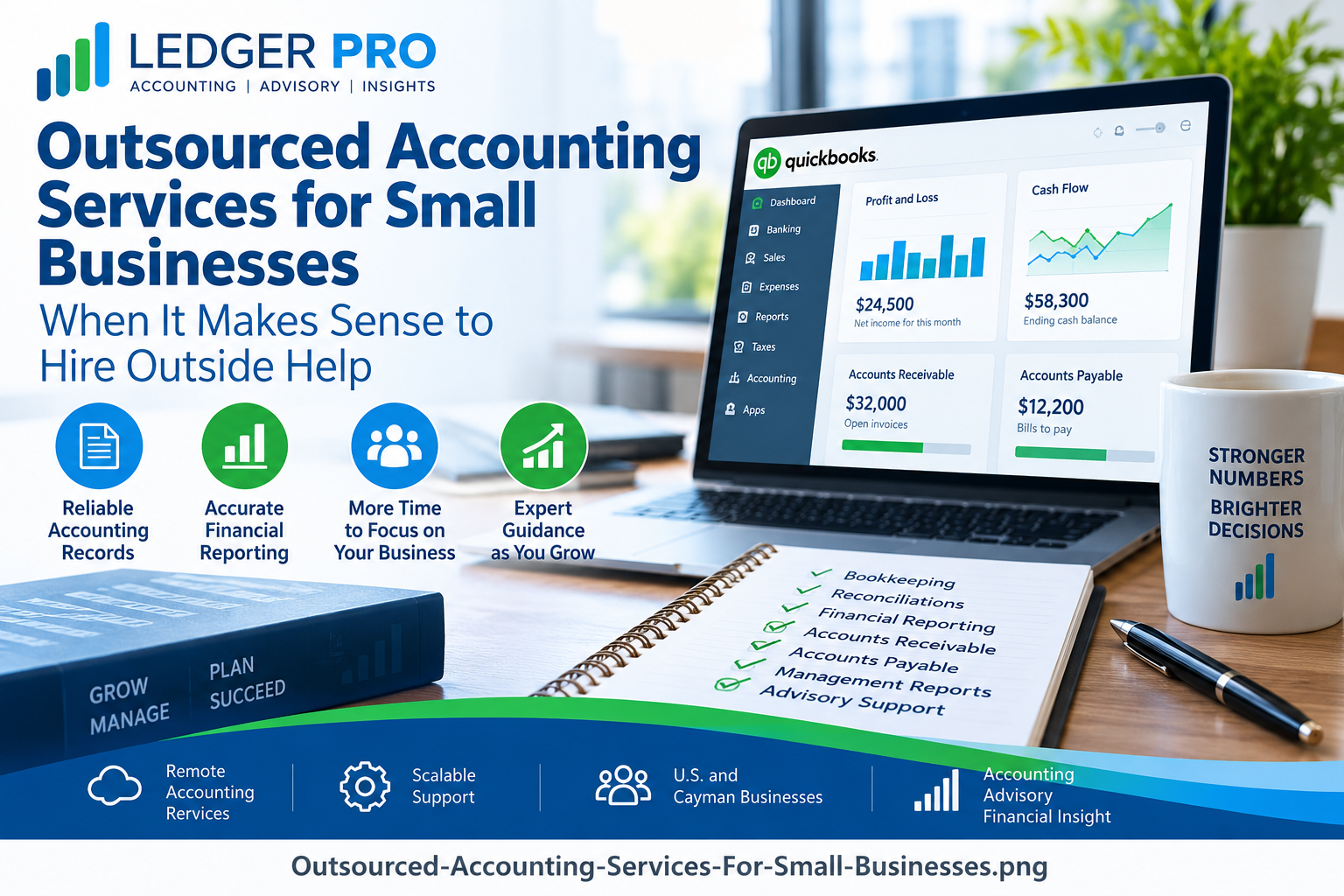
As a small business grows, managing its accounting can become increasingly difficult. There are more transactions to reconcile, more bills and receivables to monitor, more financial reports to review and more questions that need reliable financial information to answer.
Yet hiring a full internal accounting team may be unnecessary or too expensive. Outsourced accounting services for small businesses provide another option by giving business owners access to professional accounting and financial support without having to build the entire function in-house.
Outsourced accounting means using an external accounting professional or firm to perform some or all of the accounting functions that might otherwise be handled internally.
The exact responsibilities depend on the needs of the business, but outsourced accounting support can include:
For businesses using QuickBooks Online, outsourced accounting can also provide a structured process for keeping the accounting system current while reviewing whether the information produced by the system remains reliable.
Many businesses begin with the owner, an administrator or a bookkeeper handling much of the accounting. That approach may work while transaction volumes and financial complexity remain relatively low.
As the business grows, however, accounting requirements can begin consuming management time while the financial information becomes increasingly important to business decisions.
Businesses do not always recognize immediately when their accounting needs have outgrown their existing process. Problems often become visible gradually.
If the underlying QuickBooks records are already unreliable, outsourcing the ongoing accounting process may need to begin with a cleanup or structured financial review.
Learn more in our QuickBooks Cleanup Services for Small Businesses guide .
Bookkeeping and accounting are related, but they are not necessarily the same level of financial support.
Bookkeeping generally focuses on maintaining the underlying transaction records. Depending on the engagement, this may include recording transactions, categorization, reconciliations and maintaining customer and vendor information.
Outsourced accounting can extend beyond transaction processing to include reviewing the accounting records, evaluating account balances, preparing financial reports and helping management understand financial results.
Before relying on financial reports, the underlying accounting records should be reviewed systematically.
Ledger Pro's QBO Client Review Benchmark provides additional guidance on areas that can be reviewed when evaluating QuickBooks Online accounting records.
One of the advantages of a structured outsourced accounting relationship is establishing a regular financial review cadence rather than waiting until tax preparation or year-end to discover accounting problems.
A monthly review can help identify unusual balances, reconciliation problems, changing expense patterns, overdue receivables and other issues while the information is still timely.
See our Monthly Financial Review for Small Business guide for the financial areas management should be monitoring regularly.
Maintaining accounting records is important, but management should ultimately receive financial information that can be used to understand the business.
Depending on the business and engagement, useful reporting may include:
Our Management Reporting for Small Businesses guide explains why standard financial statements sometimes need additional interpretation before they become useful management information.
Outsourced accounting does not create cash by itself, but maintaining reliable accounting records can give management much better visibility into the factors affecting cash.
For example, regular accounting review can make it easier to identify:
For additional guidance, see Cash Flow Advisory for Small Businesses and Working Capital Management for Small Businesses .
Whether to outsource accounting or hire internally depends on the size, complexity and operating needs of the business.
Cloud accounting platforms such as QuickBooks Online make it possible for many accounting functions to be performed remotely. Financial records can be reviewed, reconciliations completed and reports discussed without requiring the accounting provider to work permanently from the client's location.
This can be particularly useful for businesses that need professional accounting support but do not need another full-time employee physically located in their office.
As financial complexity increases, some businesses need more than routine accounting and monthly reporting. Management may require stronger oversight, budgeting, forecasting, KPI monitoring and interpretation of financial results.
At that stage, a fractional controller service may provide the additional level of financial oversight the business needs without immediately hiring a full-time controller.
A successful transition should begin by understanding the condition of the existing accounting records and defining who will be responsible for each part of the accounting process.
The appropriate frequency depends on transaction volume and the financial needs of the business, but waiting until year-end is generally too late for information intended to support management decisions.
Ledger Pro provides remote accounting, financial review and advisory support designed to help small businesses maintain more reliable financial information and understand what their numbers are showing.
Depending on the scope of the engagement, support may include:
The appropriate level of support depends on the condition of your accounting records, transaction volume, reporting requirements and how much ongoing financial review your business needs.
Review the available Ledger Pro Plans & Pricing to compare available service options.
If accounting is taking too much of your time, financial reports are unreliable or your business needs more structured financial support, the first step is to understand what is happening in the existing accounting records and what level of support the business actually needs.
Ledger Pro can help review your current accounting process and discuss whether outsourced accounting, cleanup support or a higher level of financial oversight may be appropriate.
Book a Consultation Contact Ledger Pro
Outsourced accounting services allow a business to use an external accounting professional or firm for functions such as bookkeeping, reconciliations, financial reporting, month-end review and financial analysis instead of handling every accounting responsibility internally.
Not necessarily. Bookkeeping generally focuses on maintaining transaction records. Outsourced accounting can extend further into account review, financial reporting, management reporting and interpretation of financial results.
Outsourcing may be worth considering when accounting consumes too much management time, reconciliations or reporting are falling behind, financial information is unreliable or the business needs professional accounting support without hiring a complete internal accounting team.
Yes. Ledger Pro provides QuickBooks Online accounting review and related financial support. If the existing records contain reconciliation problems, unusual balances or other accounting issues, a review or cleanup may be appropriate before establishing the ongoing accounting process.