Your business can have reconciled accounts, monthly financial statements and accounting software and still lack the financial information you need to make confident management decisions.
The issue is not simply whether reports are being produced. The more important question is whether those reports are helping you understand profitability, cash flow, operating trends, risks and what may require management attention next.
Standard financial statements provide essential accounting information, but business owners often need additional context before that information becomes useful for decision-making.
Effective management reporting turns accounting information into a clearer picture of how the business is performing and what may need to change.
Many businesses receive regular financial statements but still struggle to use them effectively. The following warning signs may indicate that the reporting process needs more management focus.
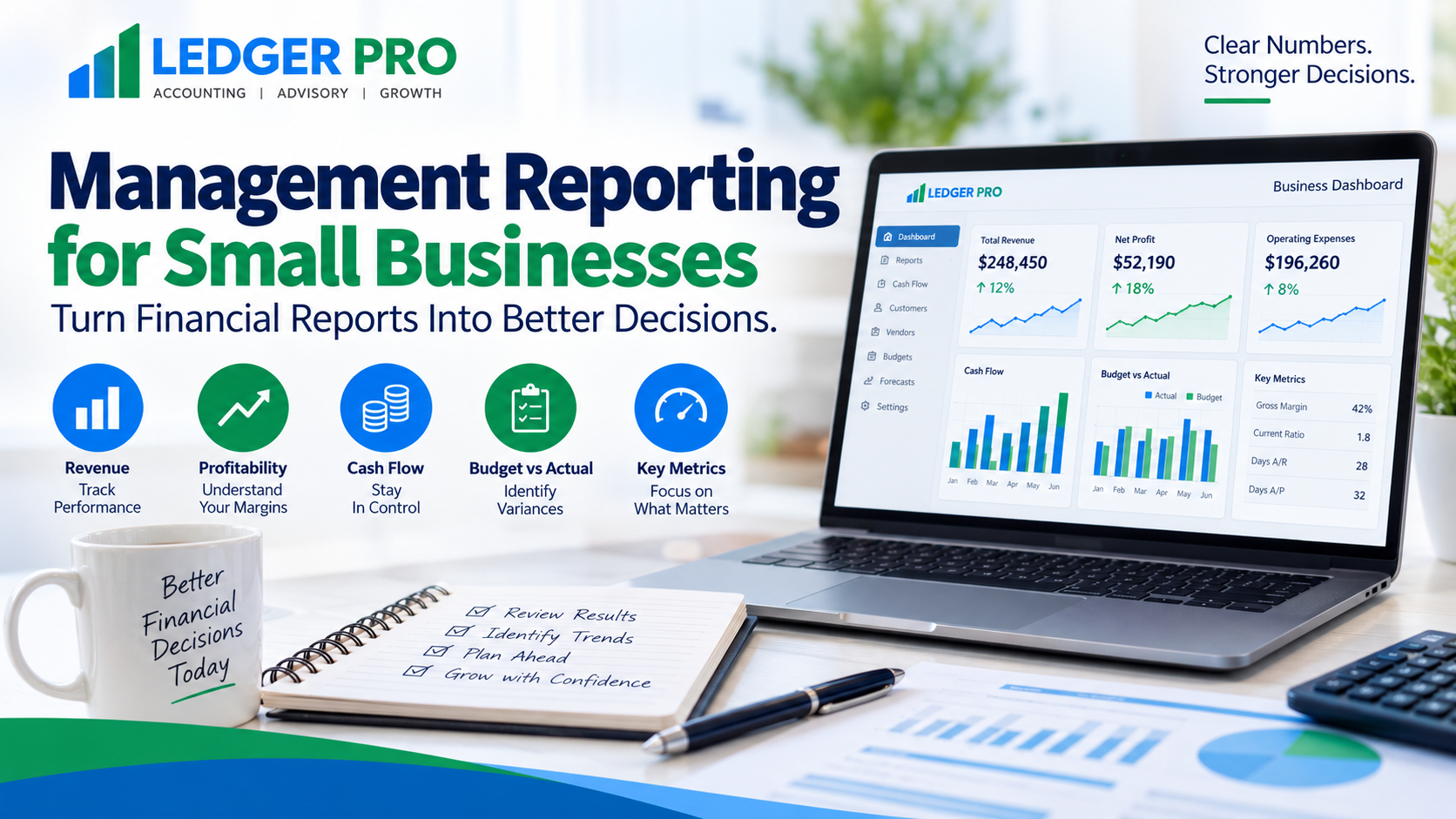
The exact reporting package should reflect the size, complexity and financial priorities of the business. However, useful management reporting commonly includes several core areas.
Revenue and expenses should be reviewed together so management can understand whether increased sales are actually producing stronger profitability.
Our Profitability Analysis for Small Businesses guide explains why revenue alone does not provide a complete picture of financial performance.
Management should understand not only current cash balances but also the expected timing of cash receipts, payments and other obligations.
Learn more in our Cash Flow Advisory for Small Businesses guide.
Receivables should be monitored for overdue balances, collection trends and changes in customer payment behaviour.
See Accounts Receivable Management for Small Businesses for additional guidance.
Management reporting should provide visibility into vendor bills, upcoming payment requirements and the effect of those obligations on cash.
Our Accounts Payable Management for Small Businesses guide explains how payables connect to liquidity and working capital.
Expense trends should be reviewed to determine whether costs are increasing faster than revenue or whether particular categories deserve further investigation.
See Expense Management for Small Businesses for practical cost-control guidance.
Cash, receivables, payables and other short-term balances should be viewed together when assessing the financial capacity of the business to support day-to-day operations.
Learn more in Working Capital Management for Small Businesses .
Comparing actual results with the budget can help identify areas where performance differs materially from expectations.
See our Budget vs Actual Analysis for Small Businesses guide.
Historical results explain what has happened. Forecasting helps management consider what may happen next based on current trends and assumptions.
Our Financial Forecasting for Small Businesses guide explains how forecasts can improve forward-looking financial visibility.
Selected KPIs can help management focus quickly on the financial measures that matter most to the business.
See Key Performance Indicators for Small Businesses for examples of financial measures that may deserve regular review.
A financial report may tell you that revenue increased by 12 percent. That is useful information, but management reporting should go further.
Management may also need to understand:
Management reporting can also help business owners evaluate whether current sales levels and margins are sufficient to cover operating costs and achieve desired profit targets.
Our Break-Even Analysis for Small Businesses guide explains how sales, costs and contribution margin can be used to establish practical financial benchmarks.
Monthly reporting is an appropriate baseline for many established businesses because it provides a regular opportunity to evaluate financial performance and identify emerging issues.
More frequent review may be appropriate when:
For additional guidance on regular financial review, see Monthly Financial Review: What Small Business Owners Should Be Watching .
Management reporting depends on the integrity of the underlying accounting information. Unreconciled accounts, misclassified transactions, unusual balances or incomplete receivable and payable records can distort financial analysis.
Before relying heavily on QuickBooks Online information for management decisions, it is important to understand whether the accounting records are complete and internally consistent.
Review Ledger Pro's QuickBooks Online Client Review Benchmark to see the areas that should be reviewed before relying on the books for management analysis.
Ledger Pro helps established and growing businesses move beyond simply producing financial statements by providing practical financial review and advisory support.
Depending on your business needs, Ledger Pro can help with:
If your financial reports are not providing clear visibility into profitability, cash flow, working capital and financial performance, Ledger Pro can help you identify what deserves attention and develop a more useful financial-management process.
Or review our accounting and advisory options:
View Ledger Pro Plans & Pricing Review the QBO Client Review Benchmark
Management reporting organizes financial information around the issues business owners and managers need to understand, including profitability, cash flow, expenses, working capital, budgets, forecasts and key performance indicators.
Financial statements report financial results and financial position. Management reporting adds comparisons, trends, KPIs and interpretation that can help management understand what is changing and where attention may be required.
Monthly review is appropriate for many established businesses. More frequent review may be useful when cash flow is tight, the business is growing quickly, financial performance is changing materially or significant management decisions are approaching.
Yes. However, useful management reporting depends on the reliability of the underlying accounting records. Ledger Pro can help review QuickBooks Online information and identify areas that may require attention before relying on the reports for important management decisions.