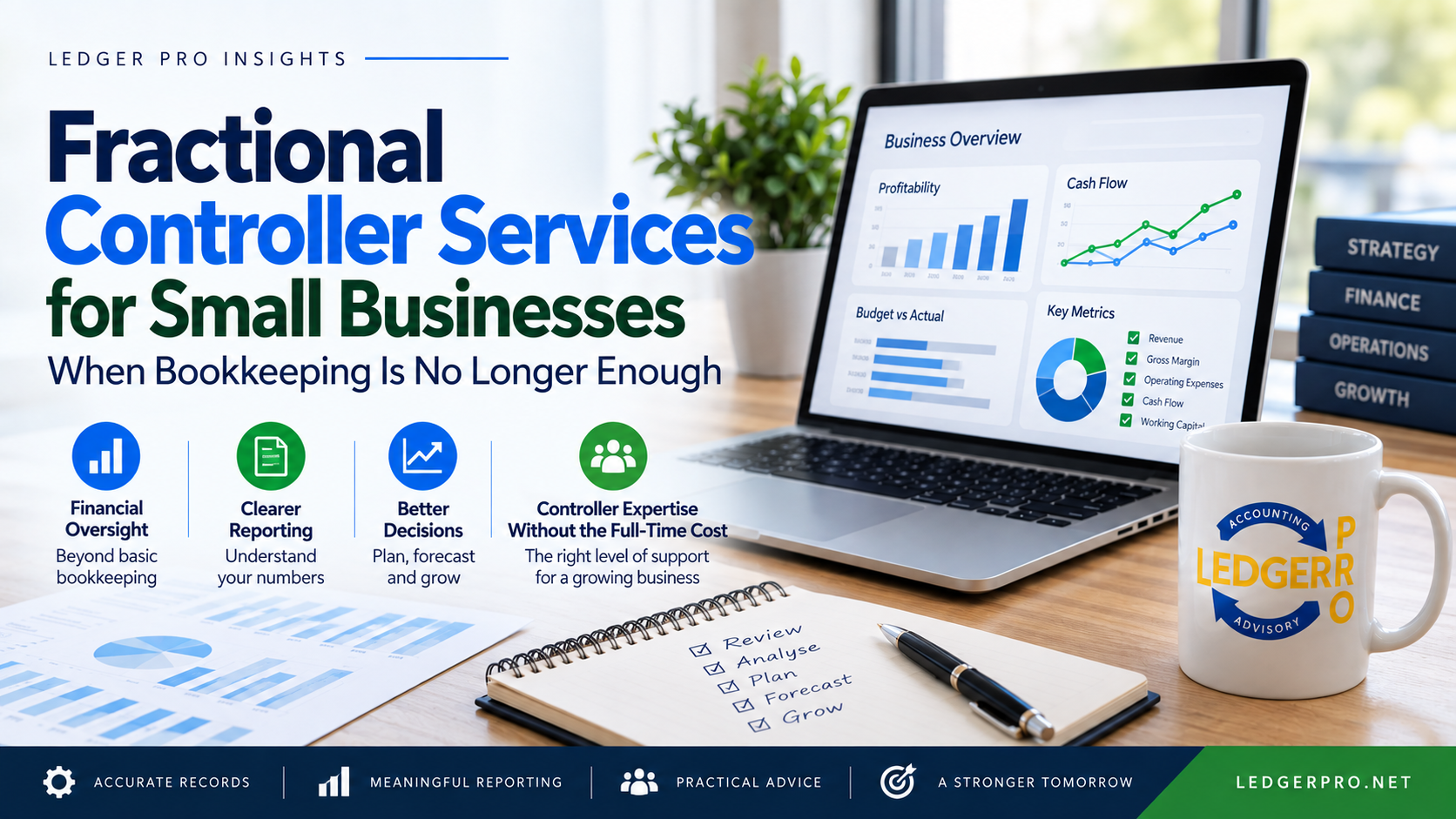
Your bookkeeper may be doing exactly what you hired them to do. Transactions are recorded, accounts are reconciled and financial statements are produced. But as a business grows, management often begins asking questions that bookkeeping alone was never designed to answer.
Why did profitability change? Why is cash tight despite increasing sales? Are expenses growing too quickly? Can the business afford another employee? Are financial reports reliable enough to support important decisions?
This is where fractional controller services for small businesses can provide an additional level of financial oversight.
What Are Fractional Controller Services?
A controller traditionally oversees the accounting function of a business. Responsibilities may include reviewing financial statements, supervising month-end processes, monitoring balance sheet accounts, improving reporting and helping ensure that management receives reliable financial information.
A fractional controller provides some or all of this higher-level financial oversight on an outsourced or part-time basis.
For a small or growing business, this can provide access to controller-level financial review and advisory support without creating another full-time management position.
- Financial statement review and oversight.
- Month-end accounting review.
- Balance sheet and reconciliation review.
- Management reporting.
- Cash flow analysis.
- Accounts receivable and payable oversight.
- Profitability and margin analysis.
- Working capital monitoring.
- Budget-to-actual analysis.
- Financial forecasting.
- Key performance indicator monitoring.
- Financial decision support.
Bookkeeper vs Accountant vs Fractional Controller
These roles can overlap, particularly in smaller businesses, but they generally address different levels of the accounting and financial management process.
Bookkeeping
Bookkeeping generally focuses on recording and maintaining the financial activity of the business.
- Recording transactions.
- Maintaining the general ledger.
- Processing or recording bills and payments.
- Recording customer receipts.
- Bank and credit card reconciliations.
- Maintaining supporting accounting records.
Accounting
Accounting builds on the bookkeeping process by reviewing, adjusting, organizing and reporting financial information.
- Financial statement preparation and review.
- Adjusting journal entries.
- Account analysis.
- Period-end review.
- Financial reporting.
- Support for tax and year-end accounting requirements.
Fractional Controller Support
Controller-level support adds another layer of oversight by helping management evaluate the reliability, meaning and usefulness of the financial information being produced.
- Review the quality of financial reporting.
- Identify unusual balances or accounting issues.
- Monitor financial trends and significant variances.
- Review profitability, cash flow and working capital.
- Develop more useful management reporting.
- Compare actual results with budgets and expectations.
- Help management interpret financial results.
Signs Your Business May Have Outgrown Basic Bookkeeping
Needing more financial oversight does not necessarily mean that something is wrong with your bookkeeping. It may simply mean the business has become more complex and management now needs more from its financial information.
- Financial statements are produced but nobody regularly interprets them.
- Month-end reporting is inconsistent or delayed.
- You are uncertain whether important balance sheet accounts are accurate.
- Revenue is growing but cash flow remains difficult to understand.
- Profitability is changing and the reasons are not immediately clear.
- Management lacks a regular financial reporting package.
- Budgets are prepared but actual performance is not compared with them.
- The business does not have meaningful financial KPIs.
- Accounts receivable or accounts payable require greater oversight.
- Bookkeeping staff need higher-level accounting review.
- Important decisions are being made without enough financial analysis.
What Does a Fractional Controller Actually Do?
The exact scope should reflect the needs of the business. For many small businesses, the following areas provide the foundation for useful controller-level support.
Month-End Financial Review
Month-end should involve more than simply producing financial statements. Important accounts should be reviewed, unusual balances investigated and significant changes identified before management relies on the reports.
Our monthly financial review guide explains the areas small business owners should regularly monitor.
Balance Sheet Oversight
The balance sheet can reveal accounting issues that may not be obvious from the profit and loss statement. Cash, receivables, payables, loans, credit cards, payroll liabilities and other significant accounts should be reviewed for reasonableness.
Management Reporting
Standard accounting reports are useful, but management often needs information organized around the questions required to operate the business.
A structured management reporting process can help transform accounting information into a clearer view of profitability, cash flow, working capital and financial performance.
Profitability and Margin Analysis
Revenue growth does not automatically mean that a business is becoming more profitable. Supplier costs, payroll, operating expenses, pricing and product or service mix can all affect the amount of profit ultimately generated.
Regular profitability analysis can help management understand whether revenue growth is translating into stronger margins and improved financial performance.
Cash Flow Oversight
Reported profit and available cash are not the same thing. Customer collections, supplier payments, payroll, taxes, loan payments and other commitments can create cash pressure even when the income statement reports a profit.
Regular cash flow analysis can help management understand where cash is being generated, where it is being used and what upcoming obligations may require attention.
Working Capital Management
A growing business may require increasing amounts of cash to support receivables, inventory, supplier obligations and other short-term operating requirements.
Reviewing working capital management helps management understand how current assets and current liabilities are affecting liquidity and the business's ability to support normal operations and growth.
Accounts Receivable Oversight
Increasing sales provide limited benefit to liquidity if customers are not paying within reasonable terms. Receivable balances, aging and collection patterns should therefore be monitored as part of the financial review.
Learn more about accounts receivable management .
Accounts Payable Oversight
Management should also understand upcoming supplier obligations and how payment timing affects available cash and working capital.
Our guide to accounts payable management explains why payables should be considered as part of broader cash management.
Compare Actual Performance With the Plan
Financial reports become more useful when management can compare actual performance with expectations.
A budget vs actual analysis can identify meaningful differences in sales, margins, payroll, operating expenses and other financial measures.
Controller-level review should go beyond identifying the variance. The more useful questions are why the variance occurred, whether it is likely to continue and whether management assumptions should change.
Look Forward With Financial Forecasting
Historical accounting information explains what has already happened. Growing businesses also need to consider what may happen next.
Financial forecasting can help management evaluate the possible effects of changing revenue, margins, expenses, staffing and cash requirements.
- Can the business afford an additional employee?
- What happens if revenue grows more slowly than expected?
- How will a supplier cost increase affect gross margin?
- Will upcoming spending create additional cash pressure?
- What happens if customers take longer to pay?
- How much working capital may be required to support growth?
Monitor the Financial Indicators That Matter
A growing business can generate dozens of accounting reports and hundreds of financial numbers. Management does not need to monitor every number equally.
A carefully selected group of key performance indicators can help focus attention on the areas most relevant to financial performance.
- Gross profit margin.
- Net profit margin.
- Operating expense trends.
- Accounts receivable days.
- Accounts payable days.
- Working capital.
- Current ratio.
- Operating cash flow.
Understand the Financial Threshold Behind Growth Decisions
Hiring additional employees, leasing more space, purchasing equipment or increasing other fixed costs may require the business to generate additional sales before the decision contributes positively to profit.
A break-even analysis can help management understand how much revenue may be required to cover fixed and variable costs before committing to a significant new expense.
Move From Financial Reporting to Financial Decision Support
Producing reliable reports is essential, but the real management value comes from understanding what those reports mean for the business.
Fractional controller support can help connect financial reporting with the decisions management is considering.
For example, before hiring another employee, management may need to understand current profitability, available cash, expected revenue growth and the additional sales required to support the new fixed cost.
Before purchasing equipment, management may need to consider the initial cash requirement, financing obligations and the expected financial benefit of the investment.
Our guide to financial decision support for small businesses explains how accounting information can be used to evaluate these types of management questions.
Fractional Controller vs Fractional CFO
Fractional controller and fractional CFO services are sometimes described interchangeably, but they generally address different levels of financial management.
Fractional Controller
- Accounting oversight.
- Month-end review.
- Financial statement reliability.
- Management reporting.
- Cash flow monitoring.
- Budget-to-actual analysis.
- Financial controls and accounting processes.
- KPIs and financial performance analysis.
Fractional CFO
- Long-term financial strategy.
- Capital structure and financing strategy.
- Investor or lender relationships.
- Major corporate transactions.
- Strategic financial planning.
- Higher-level financial leadership.
Many established small businesses do not yet require CFO-level financial leadership. Their more immediate need may be reliable accounting, disciplined month-end review, stronger management reporting and better interpretation of financial results.
Controller-Level Reporting Still Depends on Reliable Accounting Data
Better reporting cannot compensate for unreliable accounting records. Before management relies on financial information, there should be reasonable confidence that important accounts are complete, reconciled and properly classified.
Common issues can include:
- Unreconciled bank or credit card accounts.
- Old or inaccurate accounts receivable balances.
- Unresolved accounts payable balances.
- Duplicate or incorrectly categorized transactions.
- Unusual balance sheet accounts.
- Incorrect opening balances.
- Payroll or sales tax liabilities that do not reconcile.
- Transactions posted to inappropriate accounts.
Review the QBO Client Review Benchmark
How Often Should Controller-Level Financial Review Take Place?
The appropriate frequency depends on the business, but controller-level review is generally most useful when it becomes part of a regular management process rather than an occasional year-end exercise.
- Weekly: Cash balances, significant collections and upcoming payments may require monitoring when liquidity is tight.
- Monthly: Financial statements, balance sheet accounts, profitability, cash flow, receivables, payables and KPIs should generally be reviewed.
- Quarterly: Budgets, forecasts, trends and broader financial assumptions can be revisited.
- Before major decisions: Relevant financial information should be reviewed before significant hiring, borrowing, investment, pricing or expansion decisions.
Which Businesses May Benefit From Fractional Controller Support?
Fractional controller services can be particularly relevant for established or growing businesses that already have bookkeeping or accounting systems in place but need stronger financial oversight.
- Growing businesses whose accounting needs have become more complex.
- Owner-managed businesses that need better financial visibility.
- Businesses with bookkeeping staff who need higher-level review.
- Companies receiving financial reports without enough interpretation.
- Businesses experiencing recurring cash flow pressure.
- Companies beginning to use budgets, forecasts or management KPIs.
- Businesses preparing for further growth or expansion.
- Organizations that need controller-level support but not a full-time controller.
What You'll Get With Ledger Pro
Ledger Pro provides remote accounting, financial review and advisory support designed to help small businesses obtain clearer and more useful financial information.
Depending on the needs of your business, support can include:
- Review of QuickBooks Online accounting information.
- Financial statement and balance sheet review.
- Month-end financial review.
- Profitability and margin analysis.
- Cash flow and working capital review.
- Accounts receivable and accounts payable analysis.
- Management reporting.
- Budget-to-actual analysis.
- Financial forecasting.
- Relevant financial KPI monitoring.
- Financial interpretation and decision support.
The goal is to provide the level of financial oversight appropriate for your business without adding unnecessary complexity.
Which Ledger Pro Plan Should You Choose?
The appropriate level of support depends on the condition of your accounting records, the complexity of the business and how much ongoing financial review and advisory support management requires.
A business primarily needing routine accounting support may require a different service level from a growing company that needs recurring financial review, management reporting and advisory support.
View Ledger Pro Plans & Pricing
Has Your Business Outgrown Basic Bookkeeping?
If your transactions are being recorded but you still do not have the financial visibility you need to manage the business confidently, adding more bookkeeping may not solve the underlying problem.
The next step may be a more structured review of your accounting records, financial reports and management information.
Schedule a conversation with Ledger Pro. We can discuss your current accounting process, the financial information you are receiving and the areas where stronger oversight may help.
Book a Financial Review View Plans & Pricing
Prefer to contact us directly? Email Ledger Pro .
Frequently Asked Questions
What does a fractional controller do for a small business?
A fractional controller provides higher-level financial oversight without requiring the business to employ a full-time controller. Services can include financial statement review, month-end oversight, management reporting, cash flow analysis, budgeting, forecasting, KPIs and accounting process review.
What is the difference between a bookkeeper and a fractional controller?
A bookkeeper generally focuses on recording and maintaining financial transactions. A fractional controller provides additional oversight and analysis, helping management evaluate the accuracy of financial information, understand performance and use the numbers for business decisions.
When does a small business need fractional controller services?
A business may benefit when its accounting has become more complex, management needs better financial reporting, cash flow requires closer attention, budgets and forecasts are needed, or the owner is receiving financial statements without enough interpretation.
Do I need a fractional controller or a fractional CFO?
The appropriate service depends on the business's needs. Controller services generally focus on accounting oversight, reporting, financial controls and management information. CFO-level services typically extend further into strategic financing, capital structure, investor relationships and broader corporate financial strategy.